FramanAgridev Development Company Ltd
 |
|---|
 |
 |
 |
 |
Corn
Corn is the primary Nigeria and African feed grain, accounting for more than 95 percent of total feed grain production and use.
More than 90 million acres of land are planted to corn, with the majority of the crop grown in the Heartland region. Most of the crop is used as the main energy ingredient in livestock feed, corn is also processed into a multitude of food and industrial products including starch, sweeteners, corn oil, beverage and industrial alcohol, and fuel ethanol. Some 600,000 farm households depend on corn as a major source of livelihood, in addition to transport services, traders, processors and agricultural input suppliers who directly benefit from corn production, processing, marketing and distribution.
Corn is a multipurpose summer cereal, grain and silage crop. It is a good rotation crop with legumes and cotton. Maize has a low capital investment, low growing risk and generally a longer window of harvest than other crops. The industry is valued between $25-$35 million annually, depending upon prices, area planted, and yields. Maize is predominantly grown for the domestic market, although a small amount - usually specialised varieties - is grown for export (e.g. waxy or white types).
 |
|---|
 |
 |
 |
 |
Plantain
Plantain resemble banana but are longer in length, have a thicker skin, and contain more starch. They are also a major staple food in Africa, Latin America, and Asia. They are usually cooked and not eaten raw unless they are very ripe. Plantains are more important in the humid lowlands of West and Central Africa. One hundred or more different varieties of plantain grow deep in the African rainforests.
Banana and plantain are perennial crops that take the appearance of trees as they mature. Diverse cultivars are grown. Musa are believed to have originated in Southeast Asia but their introduction into Africa is unclear.
Throughout history Musa has provided humans with food, medicine, clothing, tools, shelter, furniture, paper, and handicrafts. It could be termed the "first fruit crop" as its cultivation originated during a time when hunting and gatherings were still the principal means of acquiring food.
Musa are rich in vitamin C, B6, minerals and dietary fibre. They are also a rich energy source, with carbohydrates accounting for 22% and 32% of fruit weight for banana and plantain, respectively
 |
|---|
 |
 |
 |
 |
Yam
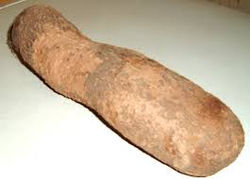
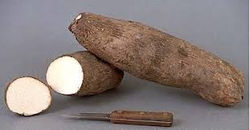
Yams are starchy staples in the form of large tubers produced by annual and perennial vines grown in Africa, the Americas, the Caribbean, South Pacific and Asia. There are hundreds of wild and domesticated Dioscorea species. White Guinea yam, D. rotundata, is the most important species especially in the dominant yam production zone in West and Central Africa. It is indigenous to West Africa, as is the Yellow yam, D. cayenensis. Water yam, D. alata, the second most cultivated species, originated from Asia and is the most widely distributed species in the world.
Yams are primary agricultural commodities and major staple crops in Africa, where yam cultivation began 11,000 years ago. In West Africa they are major sources of income and have high cultural value. They are used in fertility and marriage ceremonies, and a festival is held annually to celebrate its harvest. Consumer demand for yam is generally very high in this sub-region and yam cultivation is very profitable despite high production costs.
Yam tubers consist of about 21% dietary fiber and are rich in carbohydrates, vitamin C and essential minerals. Worldwide annual consumption of yams is 18 million tons, with 15 million in West Africa. Annual consumption in West Africa is 61 kilograms per capita. Yams are boiled, roasted, baked or fried. In Africa they are also mashed into a sticky paste or dough after boiling.

A Nigerian-Israeli leading provider of Agricultural Products, Infrastructure & Environmental Solutions.